Alexa Alice Joubin

Shakespeare

How AI Changes Theatrical Publics

How AI Changes Theatrical Publics

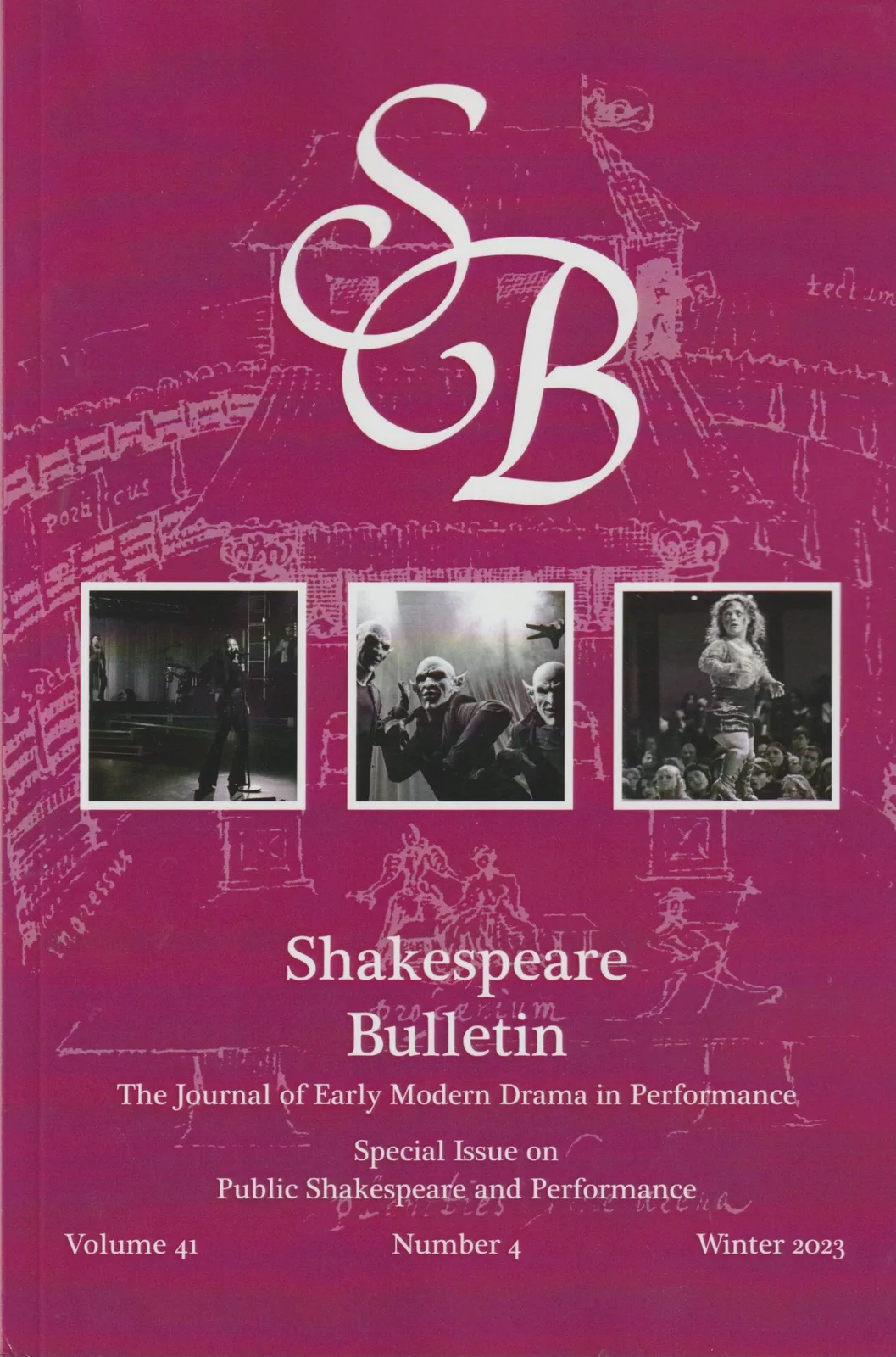
Shakespeare Bulletin 41.4 (Winter 2023): 529-553

When AI goes to theater with humans, it changes the dynamics of the social space. This article examines a case of audiences being asked by organizers to use an AI app on their phones to translate a sign language performance. This study draws on interface theories to analyze the roles of screens in regulating publics’ access to performance, producing new ambient conditions of theatergoing and changing the publics’ relationships to themselves and to performance. AI s creens in All the World’s a Screen, an Irish Sign Language production, served and became co-spectating theatrical publics. Operating both within and beyond the fabula of the performance, screens as anthropomorphic interfaces create multiple theatrical publics through an imperfect spectatorial proxy.
DOIFull TextJournal Website

Shakespeare and East Asia

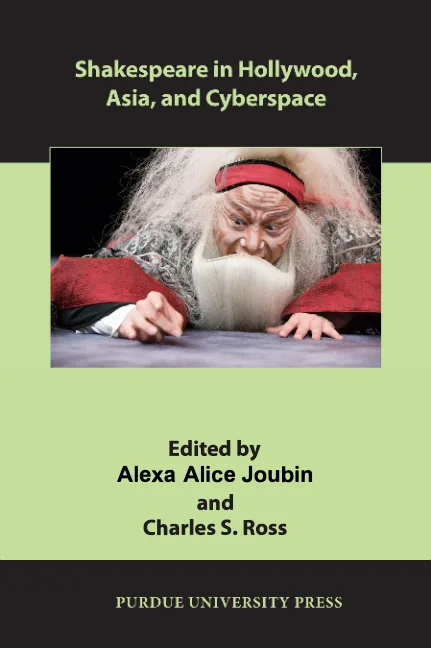
Oxford University Press, 2021 Four themes distinguish post-1950s East Asian cinemas and theaters from works in other parts of the world: Japanese innovations in sound and spectacle; Sinophone uses of Shakespeare for social reparation; the reception of South Korean presentations of gender identities in film and touring productions; and multilingual, disability, and racial discourses in cinema and diasporic theatre in Asian America, Singapore, and the UK. How do actors reposition their racialized bodies on stage and on screen? How did Akira Kurosawa influence George Lucas’ Star Wars ? How do East Asian cinema and theatre portray vocal disability? How do Korean transgender cinema and feminism transform gender identities in Shakespeare? Bringing film and theatre studies together, this book sheds new light on the two major genres in a comparative context and reveals deep connections among Asian and Anglophone performances.

SAMPLE CHAPTERBUY

Performativity and Trans Literature

Performativity and Trans Literature

The Routledge Handbook of Trans Literature , ed. Douglas A. Vakoch and Sabine Sharp (2024), 29-39

Performativity—how language tacitly or overtly affects social actions—is the core of all utterances and imaginative literature. This chapter examines transness in what might be called body-swap narratives, including Virginia Woolf’s Orlando and Sally Potter’s film adaptation of it, Makoto Shinkai’s film Your Name , the Wachowski Sisters’ Matrix trilogy, as well as Shakespeare’s Twelfth Night and Trevor Nunn’s and Andy Fickman’s film versions of the comedy. Joubin’s theory of performativity hinges on the ideas that gender are social practices and interpersonal relationships that evolve over time and in different social spaces and that these practices are constituted, and sometimes undermined, by performative speech acts. Performativity destabilizes the idea of singularity and the perceived absolutism of such signifiers as gender.

DOIFULL TEXT

Trans Studies at the Crossroad: From Racialized Invisibility to Gendered Legibility

The Oxford Handbook of Shakespeare and Race , ed. Patricia Akhimie (Oxford University Press, 2024), pp. 195-211. This chapter argues that race and gender are social practices that evolve over time, in each other’s presence, and in different social spaces. Bringing critical race theory and trans studies together, this chapter examines racial and gendered otherness through case studies of performances of Shakespeare’s plays. To correct the early modern studies’ tendency to privilege narrative texts, this chapter uses global and performance studies methods—as critical tools that are designed to capture transformative cultural practices—to highlight embodied significations of transness. The chapter concludes with a reflection on pedagogical implications of multidisciplinarity. Providing critical tools to understand atypical bodies, trans studies solidifies critical race studies’ support of minority life experiences.

FULL TEXTOxford website

Screening Social Justice: Performing Reparative Shakespeare against Vocal Disability

Screening Social Justice: Performing Reparative Shakespeare against Vocal Disability

Adaptation 14.2 (August 2021): 187–205; DOI: 10.1093/adaptation/apaa031 Many screen and stage adaptations of the classics are informed by a preconceived notion that performing the canon can make one a better person. Inspirational narratives, in particular, have instrumentalized the canon to serve socially reparative purposes. Social recuperation of disabled figures loom large in adaptation, and many reparative adaptations tap into a curative quality of Shakespearean texts. Governing the disability narrative is the trope about Shakespeare’s therapeutic value. There are two strands of recuperative adaptations. The first is informed by the assumption that the dramatic situations exemplify moral universals. The second strand consists of adaptations that problematize heteronormativity and psychological universals in liberal humanist visions of the canon. This article identifies a common trope in reparative performances of disability in order to highlight some questions the trope raises.

FULL TEXT

Teaching Shakespeare in a Time of Hate

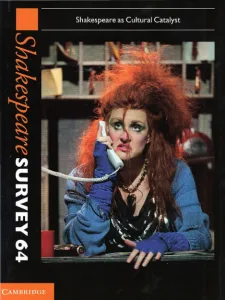
Shakespeare Survey 74 (2021): 15-29 ( open access ) Co-authored by Alexa Alice Joubin and Lisa S. Starks , this article examines new theories and praxis of listening for silenced voices and of telling compelling stories that make us human. We draw on Emmanuel Levinas’s philosophy about the Other to design classroom practices for in-person and remote instruction that foster collaborative knowledge building and intersectional pedagogy. The moral agency that comes with the cultivation of ethical treatment of one another can lead to political advocacy. Special attention is given to race, gender, and the exigencies of social justice and remote learning in the era of the global pandemic. The new normal in higher education, which is emerging at the time of writing, exposes inequities that were previously veiled by on-campus life and resources. Even as they are cause for grief and anxiety, the inequities exposed by COVID-19 can spur change for the better.

FULL TEXTBUY

Trans as Method

Trans as Method

Borrowers and Lenders: The Journal of Shakespeare and Appropriation 14.2 (2023). Open Access. This article proposes “trans” as method and as a social practice rather than as an immutable identity category that stands in opposition to more established ones such as cis-gender men or cisgender women. In Shakespeare’s times, the enactment of gender practices is not predicated upon “substitutions” (as in substituting the boy actor for Desdemona, for instance) or entail diagnostic recognition (as in being reminded of the “real” body beneath the illusion of Ophelia or Desdemona). This article outlines key issues with today’s terminology, suggests a more effective and inclusive vocabulary, elucidates trans as method, and demonstrates trans studies’ relevance to Shakespeare studies.

Full TextOpen-Access Journal

Contemporary Transgender Performance of Shakespeare

Contemporary Transgender Performance of Shakespeare

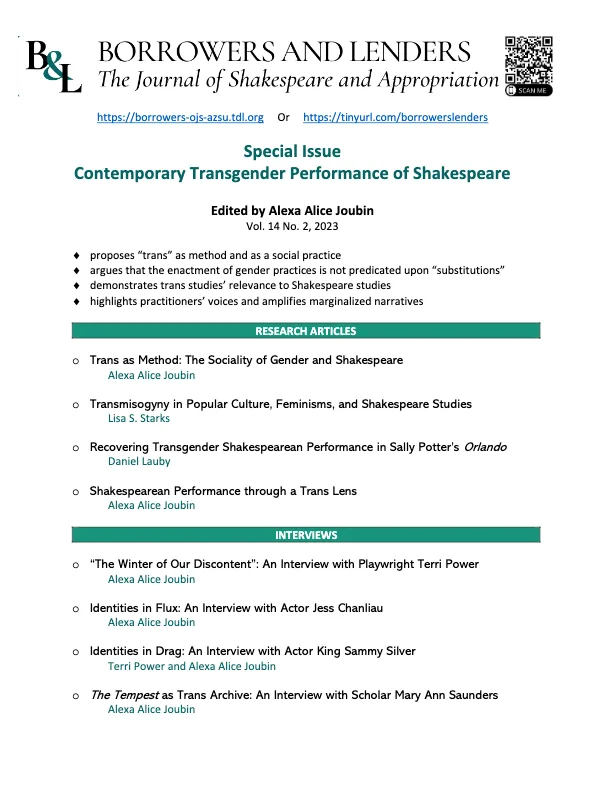
Special Issue of Borrowers and Lenders: The Journal of Shakespeare and Appropriation 14.2 (2023), edited by Alexa Alice Joubin Cross-gender roles in Shakespeare have been misunderstood as “cross-dressing.” The enactment of gender practices is not predicated upon “substitutions” (as in substituting the boy actor for Desdemona). It does not entail diagnostic recognition (as in being reminded of the “real” body beneath the illusion of Desdemona). The special issue — proposes “trans” as method and as a social practice argues that the enactment of gender practices is not predicated upon “substitutions” demonstrates trans studies’ relevance to Shakespeare studies highlights artists’ and practitioners’ voices and amplifies marginalized narratives

IntroductionOpen Access Journal

Enhancing the Trustworthiness of Generative Artificial Intelligence in Responsive Pedagogy in the Context of Humanities Higher Education

General Aspects of Applying Generative AI in Higher Education: Opportunities and Challenges , (Springer Nature, 2024), pp. 207–220 To test the hypothesis of trustworthy AI and to model best practices in education, this discusses a proof-of-concept proprietary AI Teaching Assistant designed by Professor Joubin . The project analyzes what conversational AI tools can realistically accomplish in the humanities higher education context. The study finds two substantive challenges posed by AI: singularity and mistaking synthesis for critical thinking. Joubin offers a solution to each challenge. The project also argues that AI is a ghost and synthetic version of the publics. AI throttles and controls the general public’s access to information.

FULL TEXTBUY